
11 Haziran 2014 Çarşamba

10 Haziran 2014 Salı
Brazil's Anti-World Cup Graffiti

Against this backdrop, vastly underestimated costs of building stadiums in multiple cities--at Brazil's insistence, not even FIFA's--has drawn widespread criticism. Some of the frustrations are being vented in often-violent street protests. Let them eat football? However, others have chosen to express these sentiments through more artful means. As it so happens, Yahoo! has a photo essay on this very topic--World Cup-bashing by ordinary Brazilians with some artistic abilities.The Guardian has more.
The debate rages on whether graffiti is street art or a public nuisance. The world-famous Banksy for one would argue that it's art since he's exhibited in any number of famous museums, but not all of it reaches his standards. In any case, it's certainly gotten the attention of Brazilian government officials, especially the current left-of-center government since social issues and development are foremost in its voters' concerns.
UPDATE: See Quartz on why Brazil is in a sour mood for the World Cup.
Retire the Penny
My long-time readers know that I have long favored getting rid of the penny. If you agree, you can now let the White House know via this petition.
9 Haziran 2014 Pazartesi
Can LatAm Regain Choco Mkt Share Lost to Africa?
 |
| History 101: Sharing chocos with white people wasn't such a marvy idea. |
With chocolate consumption going global, one of the trends was for Europe to become the largest consumer of it. However, since European climates proved unsuitable for cocoa growing, this proved to be something of a quandary for sourcing cocoa. The Dutch colonized Indonesia and cocoa was grown there since its climate proved to be amenable. Other Europeans followed suit: Today's largest growers trace their cocoa production to colonial times: Cote d'Ivoire (France) and Ghana (Great Britain). See the Guardian's infographic on where chocolate is produced and consumed today:
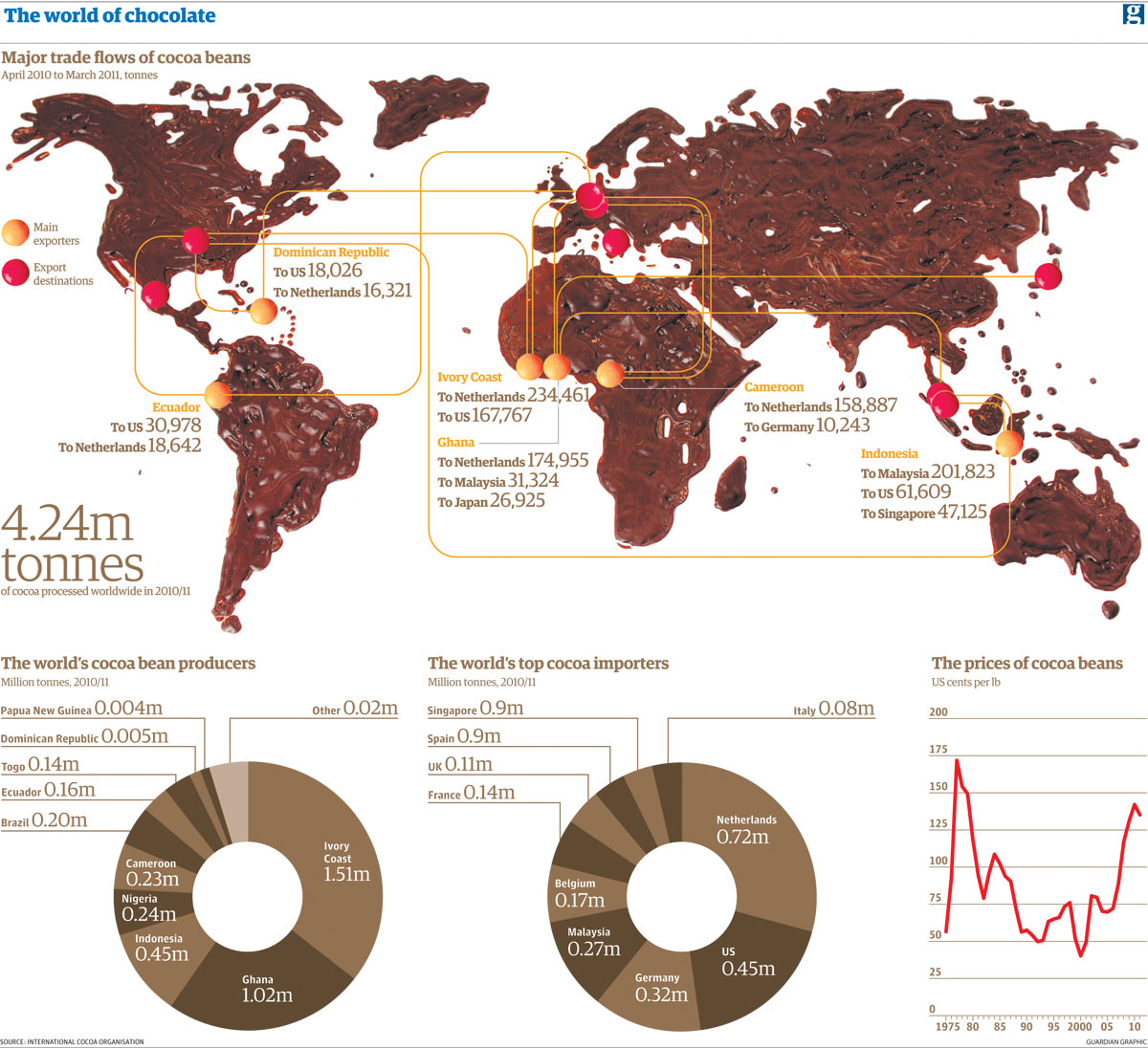
It is against this background of lost choco-hegemony to West Africa that Central and Southern American regions are attempting a comeback. First, connoisseurs of the finest European chocolates know that the best cocoa beans are grown in the place they were first "discovered." To be honest, cocoa quality is not as important for American consumers who prefer chocolates full of sugar and milk (milk chocolate) unlike European consumers who focus on the taste and texture of largely unadulterated cocoa (dark chocolate):
The cocoa beans from Central and South America are known as being of high quality — fulfilling a certain niche, especially among consumers in Europe...Second, even the likes of the Ivory Coast and Ghana may not be able to produce enough cocoa to meet global demand as China and India become populous consumers of chocolate:
But Latin America can make a dent if demand for high-quality cocoa rises. Cocoa production “could change depending on how the market evolves,” said Moises Gomez of the ICCO [International Cocoa Organization; it should be ICO then]. “Most of world demand is for normal cocoa and it comes mainly from West Africa. Fine cocoa, which accounts for five percent of demand, comes from Latin America,” Gomez said. “Europe is the biggest buyer of top-grade cocoa,” he said.
“Americans are used to chocolate with a high milk and sugar content, and for that, you do not need high-quality cocoa [read: Hersheys]. But when you want a dark cocoa with good taste, you look for cocoa from Latin America or Madagascar,” he added...
Weather conditions and soil are the things that contribute most to the taste of the various grades of cocoa, said Gomez. He said while several high grades of cocoa were planted in Africa, they were not of the same quality as those in Latin America. All the different strains, from garden variety to hybrids, grow well in Latin America. And this happens in much of the region.
Thomas Pugh, a commodities specialist with the British investment consultancy Capital Economics, predicts a fairly strong increase in Latin American supply in the coming years. “The biggest producers will continue to be in West Africa, but the forecasts for Latin America are good,” he told AFP.
Demand for cocoa from emerging countries is booming, especially in China, said Florence Pradier, the secretary general of Paris-based chocolate association Alliance 7. That, paired with a strong resurgence in demand from traditional chocolate consumers in Europe and North America, is good news for producers. According to a recent report by the French commodity research group Cyclope, demand in Asia is also being driven by India, with the strongest growth in the world at 20-25 percent a year.
So many years after the barbarity of Hernan Cortes that's been immortalized in song, it appears the Americas are on the cusp of cocoa comeback after being marginalized for so long. What's interesting is how Europeans prefer (Central and South) American chocolates to the sorts produced in their former West African colonies if given a choice, while average North American consumers couldn't care less about cocoa quality. As long as the stuff is milky and sweet, the Yanks will eat it. I guess geography was not arranged to suit tastes.
Anyway, cue up the Neil Young. Cortez, what a killer:
He came dancing across the water
With his galleons and guns
Looking for the new world
In that palace in the sun.
On the shore lay Montezuma
With his coca leaves and pearls
In his halls he often wondered
With the secrets of the worlds.
8 Haziran 2014 Pazar
A College Degree is Wasteful...Even in China

Apparently, this is not just a debate confined to American and British institutions of higher learning. Even in the developing world, the same questions are being rehearsed time and again. Over the past few years, PRC leaders have encouraged higher enrollments at state universities (which is nearly all of them). Alike in the West, however, there is growing public resistance to the often questionable platitudes that college is the key to future success. From out favorite official publication, the China Daily:
At least seven provinces and one region did not meet their recruitment goals in 2013, according to the College Enrollment Report released on Wednesday by eol.cn, one of the country's largest education portals. The provinces are Henan, Shandong, Fujian, Anhui, Hebei, Guizhou and Qinghai, along with the Xinjiang Uygur autonomous region. They are the only areas that have disclosed such figures in the past year, eol.cn reported [my emphasis; so that's everyone observed].
What's to blame? Partly it's demographics and the reluctance of parents to shell out serious cash for uncertain returns:
The worrying thing for educators form a neoclassical economic perspective is that returns to human capital should become higher as developing countries like China move up the value-added ladder. Consequently, young people and their parents should respond to these signals. However, this may not be happening (yet) as enrollments continue to fall in China. It's in part likely that Chinese universities do not provide skills required by employers (job-skill mismatches).Chen Zhiwen, editor-in-chief of eol.cn and one of the report's authors, said the situation was caused by a drop in the birth rate. "The number of newborns has been falling after peaking at 20 million in 1990 and dropped to 12 million around 2000. This is to say that the number of people aged 18 - the age when most students in China start college - will continue to drop before reaching the bottom in around 2018," Chen said. Chen also said some students and their parents had been disappointed with higher education in China and had abandoned the opportunity to go to college even after being admitted, which was a significant factor in the current situation.Last year, a series of cases were reported in which parents opposed their children going to college. This sparked heated debate over the necessity to receive a higher education. In September, a father in Chengdu, Sichuan province, objected to his daughter's decision to go to college, saying it was a waste of time and money as employment prospects for college graduates were not good. He said it was more sensible to find work after graduating from high school. In an online survey, more than 70 percent of the 10,000-plus respondents supported the father. "The case indicates that students and parents are losing their confidence in a college education," Chen said. "Universities, education specialists and officials should pay great attention to such cases, reflect on higher education and improve the situation to help people regain confidence."
Many Chinese, especially those outside of major urban centers, are practically-oriented and see more value in the employment prospects from education instead of the college experience by itself. Me? As I've said before, the German apprenticeship system certainly looks attractive to those valuing employment prospects above all. It certainly beats the US/UK uni-jobless system if you ask me, and is something I would advise China and other developing countries to consider before the Anglophone model for obvious, instrumental reasons.The US needs an overhaul, and its system of higher education would be an excellent place to start since others have come up with rather better solutions to providing employment for young people.
7 Haziran 2014 Cumartesi
Where Do Major Countries Project Their Soft Power?
 |
| Today's up-and-coming soft power enthusiasts need no introduction. |
At any rate, the point I wish to make here is that even if "soft power" is difficult to measure, that hasn't stopped any number of major countries from attempting to project better images of themselves worldwide by establishing cultural centers. The current heavyweight favorites in this respect are the Koreans, who have unleashed a Gangnam Style-torrent of entertainment products on an unsuspecting world post-Asian financial crisis. Throughout the world there are now any number of well-funded, often architecturally stunning buildings that show off the best Korean culture has to offer, from Taekwondo to, er, T-ara.


Some observations both weighty and quirky:
- That the PRC's Confucius Institutes are concentrated in Asia is no surprise, but that there are comparatively few in Africa relative to other soft power projectors is since sub-Saharan Africa is the largest regional destination for Chinese foreign aid.
- China's outsized push in the Americas is also remarkable. Is it trying to bring countries that have grown wary of US pushiness into its fold with the usual non-intervention jazz?
- Aside from the British Council, it is remarkable that no other Anglophone countries are establishing cultural centers globally. Either they think their reputation is good enough elsewhere, or they do not think establishing these centers will do much to improve their image. I cannot help but wonder how amusingly different our world would be if there were, say, US Seinfeld Institutes and Canadian Beiber Foundations to impress upon the world the desirability of their cultures. (Dear American and Canadian readers, I'm just kidding. I'm sure there are better examples.)
- While the large number of Institut Francais in sub-Saharan Africa is understandable given its colonial history in the region, the even larger number in the Middle East is unexpected and is certainly an investigable phenomenon.
Kaydol:
Kayıtlar (Atom)
11 Haziran 2014 Çarşamba
10 Haziran 2014 Salı
Brazil's Anti-World Cup Graffiti
Against this backdrop, vastly underestimated costs of building stadiums in multiple cities--at Brazil's insistence, not even FIFA's--has drawn widespread criticism. Some of the frustrations are being vented in often-violent street protests. Let them eat football? However, others have chosen to express these sentiments through more artful means. As it so happens, Yahoo! has a photo essay on this very topic--World Cup-bashing by ordinary Brazilians with some artistic abilities.The Guardian has more.
The debate rages on whether graffiti is street art or a public nuisance. The world-famous Banksy for one would argue that it's art since he's exhibited in any number of famous museums, but not all of it reaches his standards. In any case, it's certainly gotten the attention of Brazilian government officials, especially the current left-of-center government since social issues and development are foremost in its voters' concerns.
UPDATE: See Quartz on why Brazil is in a sour mood for the World Cup.
Retire the Penny
My long-time readers know that I have long favored getting rid of the penny. If you agree, you can now let the White House know via this petition.
9 Haziran 2014 Pazartesi
Can LatAm Regain Choco Mkt Share Lost to Africa?
|
| History 101: Sharing chocos with white people wasn't such a marvy idea. |
With chocolate consumption going global, one of the trends was for Europe to become the largest consumer of it. However, since European climates proved unsuitable for cocoa growing, this proved to be something of a quandary for sourcing cocoa. The Dutch colonized Indonesia and cocoa was grown there since its climate proved to be amenable. Other Europeans followed suit: Today's largest growers trace their cocoa production to colonial times: Cote d'Ivoire (France) and Ghana (Great Britain). See the Guardian's infographic on where chocolate is produced and consumed today:
It is against this background of lost choco-hegemony to West Africa that Central and Southern American regions are attempting a comeback. First, connoisseurs of the finest European chocolates know that the best cocoa beans are grown in the place they were first "discovered." To be honest, cocoa quality is not as important for American consumers who prefer chocolates full of sugar and milk (milk chocolate) unlike European consumers who focus on the taste and texture of largely unadulterated cocoa (dark chocolate):
The cocoa beans from Central and South America are known as being of high quality — fulfilling a certain niche, especially among consumers in Europe...Second, even the likes of the Ivory Coast and Ghana may not be able to produce enough cocoa to meet global demand as China and India become populous consumers of chocolate:
But Latin America can make a dent if demand for high-quality cocoa rises. Cocoa production “could change depending on how the market evolves,” said Moises Gomez of the ICCO [International Cocoa Organization; it should be ICO then]. “Most of world demand is for normal cocoa and it comes mainly from West Africa. Fine cocoa, which accounts for five percent of demand, comes from Latin America,” Gomez said. “Europe is the biggest buyer of top-grade cocoa,” he said.
“Americans are used to chocolate with a high milk and sugar content, and for that, you do not need high-quality cocoa [read: Hersheys]. But when you want a dark cocoa with good taste, you look for cocoa from Latin America or Madagascar,” he added...
Weather conditions and soil are the things that contribute most to the taste of the various grades of cocoa, said Gomez. He said while several high grades of cocoa were planted in Africa, they were not of the same quality as those in Latin America. All the different strains, from garden variety to hybrids, grow well in Latin America. And this happens in much of the region.
Thomas Pugh, a commodities specialist with the British investment consultancy Capital Economics, predicts a fairly strong increase in Latin American supply in the coming years. “The biggest producers will continue to be in West Africa, but the forecasts for Latin America are good,” he told AFP.
Demand for cocoa from emerging countries is booming, especially in China, said Florence Pradier, the secretary general of Paris-based chocolate association Alliance 7. That, paired with a strong resurgence in demand from traditional chocolate consumers in Europe and North America, is good news for producers. According to a recent report by the French commodity research group Cyclope, demand in Asia is also being driven by India, with the strongest growth in the world at 20-25 percent a year.
So many years after the barbarity of Hernan Cortes that's been immortalized in song, it appears the Americas are on the cusp of cocoa comeback after being marginalized for so long. What's interesting is how Europeans prefer (Central and South) American chocolates to the sorts produced in their former West African colonies if given a choice, while average North American consumers couldn't care less about cocoa quality. As long as the stuff is milky and sweet, the Yanks will eat it. I guess geography was not arranged to suit tastes.
Anyway, cue up the Neil Young. Cortez, what a killer:
He came dancing across the water
With his galleons and guns
Looking for the new world
In that palace in the sun.
On the shore lay Montezuma
With his coca leaves and pearls
In his halls he often wondered
With the secrets of the worlds.
8 Haziran 2014 Pazar
A College Degree is Wasteful...Even in China
Apparently, this is not just a debate confined to American and British institutions of higher learning. Even in the developing world, the same questions are being rehearsed time and again. Over the past few years, PRC leaders have encouraged higher enrollments at state universities (which is nearly all of them). Alike in the West, however, there is growing public resistance to the often questionable platitudes that college is the key to future success. From out favorite official publication, the China Daily:
At least seven provinces and one region did not meet their recruitment goals in 2013, according to the College Enrollment Report released on Wednesday by eol.cn, one of the country's largest education portals. The provinces are Henan, Shandong, Fujian, Anhui, Hebei, Guizhou and Qinghai, along with the Xinjiang Uygur autonomous region. They are the only areas that have disclosed such figures in the past year, eol.cn reported [my emphasis; so that's everyone observed].
What's to blame? Partly it's demographics and the reluctance of parents to shell out serious cash for uncertain returns:
The worrying thing for educators form a neoclassical economic perspective is that returns to human capital should become higher as developing countries like China move up the value-added ladder. Consequently, young people and their parents should respond to these signals. However, this may not be happening (yet) as enrollments continue to fall in China. It's in part likely that Chinese universities do not provide skills required by employers (job-skill mismatches).Chen Zhiwen, editor-in-chief of eol.cn and one of the report's authors, said the situation was caused by a drop in the birth rate. "The number of newborns has been falling after peaking at 20 million in 1990 and dropped to 12 million around 2000. This is to say that the number of people aged 18 - the age when most students in China start college - will continue to drop before reaching the bottom in around 2018," Chen said. Chen also said some students and their parents had been disappointed with higher education in China and had abandoned the opportunity to go to college even after being admitted, which was a significant factor in the current situation.Last year, a series of cases were reported in which parents opposed their children going to college. This sparked heated debate over the necessity to receive a higher education. In September, a father in Chengdu, Sichuan province, objected to his daughter's decision to go to college, saying it was a waste of time and money as employment prospects for college graduates were not good. He said it was more sensible to find work after graduating from high school. In an online survey, more than 70 percent of the 10,000-plus respondents supported the father. "The case indicates that students and parents are losing their confidence in a college education," Chen said. "Universities, education specialists and officials should pay great attention to such cases, reflect on higher education and improve the situation to help people regain confidence."
Many Chinese, especially those outside of major urban centers, are practically-oriented and see more value in the employment prospects from education instead of the college experience by itself. Me? As I've said before, the German apprenticeship system certainly looks attractive to those valuing employment prospects above all. It certainly beats the US/UK uni-jobless system if you ask me, and is something I would advise China and other developing countries to consider before the Anglophone model for obvious, instrumental reasons.The US needs an overhaul, and its system of higher education would be an excellent place to start since others have come up with rather better solutions to providing employment for young people.
7 Haziran 2014 Cumartesi
Where Do Major Countries Project Their Soft Power?
|
| Today's up-and-coming soft power enthusiasts need no introduction. |
At any rate, the point I wish to make here is that even if "soft power" is difficult to measure, that hasn't stopped any number of major countries from attempting to project better images of themselves worldwide by establishing cultural centers. The current heavyweight favorites in this respect are the Koreans, who have unleashed a Gangnam Style-torrent of entertainment products on an unsuspecting world post-Asian financial crisis. Throughout the world there are now any number of well-funded, often architecturally stunning buildings that show off the best Korean culture has to offer, from Taekwondo to, er, T-ara.
Some observations both weighty and quirky:
- That the PRC's Confucius Institutes are concentrated in Asia is no surprise, but that there are comparatively few in Africa relative to other soft power projectors is since sub-Saharan Africa is the largest regional destination for Chinese foreign aid.
- China's outsized push in the Americas is also remarkable. Is it trying to bring countries that have grown wary of US pushiness into its fold with the usual non-intervention jazz?
- Aside from the British Council, it is remarkable that no other Anglophone countries are establishing cultural centers globally. Either they think their reputation is good enough elsewhere, or they do not think establishing these centers will do much to improve their image. I cannot help but wonder how amusingly different our world would be if there were, say, US Seinfeld Institutes and Canadian Beiber Foundations to impress upon the world the desirability of their cultures. (Dear American and Canadian readers, I'm just kidding. I'm sure there are better examples.)
- While the large number of Institut Francais in sub-Saharan Africa is understandable given its colonial history in the region, the even larger number in the Middle East is unexpected and is certainly an investigable phenomenon.
Kaydol:
Kayıtlar (Atom)